This is an oldie but a goodie. Very low-tech, but a great way to make discoveries about things you find in your home.
In this experiment, you create a solution that will help you test for the acidity of an item.
Acidic solutions are ones that have a high concentration of hydrogen (H+) ions. These hydrogen atoms have lost an electron and now only have a proton, giving them a positive electrical charge. Solutions that are basic contain hydroxide (OH-) ions. When the two combine, you can get a pretty cool reaction. For that experiment, check out the volcano posting elsewhere on this site.
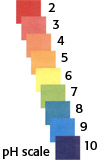
The pH scale is the way that the acidity of a solution can be measured. Acids have a pH below ,and basics have a pH above it. Something that is neither acidic or basic is distilled water-- which has a pH of 7, and an equal number of H+ and OH- ions.
Instead of using fancy litmus papers to test the acidity or basicness of a solution, you can make your own indicator at home. Simple and fun!
Materials:
1/2 a head of purple or red cabbage, chopped roughly
1 gallon of water
A large pot (like for spaghetti)
An adult who can use the stove
Coffee filters or a big slotted spoon
A large pitcher
Small clear glass bowls or cups
A variety of household items for testing (see suggestions below)
Directions:
In the pot, combine the chopped cabbage and water. Bring to a boil on the stove and simmer for 10-15 minutes. Remove from the heat and allow to cool. Using coffee filters or a big slotted spoon, remove all the cabbage pieces from the water. Transfer the cooled blue/purple water to a pitcher.
Get your household items arranged for testing.
Line up a few small glass bowls, cups or jars. Put about 1/4 a cup of the purple indicator water in each container.
Start with something like lemon juice. Add 2 tablespoons of lemon juice into the first container with purple water. What happens? Lemon is acidic, so it should turn the liquid red.
Then try some kitchen soap. Put a few squirts in the next container, and stir gently. What color does it become? Kitchen soap is basic, so the liquid should turn green.
Repeat with a variety of other things in your house. What colors are you getting? Containers that turn pinks and reds contain acidic substances. Containers that turn blue, green and yellow indicate basic substances in the mix. See what colors you can discover!
Red Cabbage pH Indicator Colors (2= highly acidic, 12= highly basic)
pH 2 4 6 8 10 12
Color red purple violet blue blue-green green-yellow
 Suggested things to test:
-lemon juice
-milk,
-amonia
-baking soda
-vinegar
-antacids (like Tums or Pepto Bismol)
-mouth wash
-seltzer water
-egg white
-soda
-iced tea
-kitchen soap
-laundry soap
-hydrogen peroxide
-ask a parent to help you find other things to try!